
Forecasting · How-to
How to Forecast Your Personal Cash Flow for the Next 14 Days
A simple two-week cash-flow forecast can show you where your bank balance is headed before the bills actually arrive. Here's how to build one.
- 01Start with available cash
- 02Add income
- 03Add obligations
- 04Estimate variable spend
- 05Find the low point
Your bank balance tells you how much money you have right now.
It doesn't tell you how much of that money is already spoken for.
Imagine you open your banking app and see $4,800 in your chequing account.
That feels comfortable.
But over the next two weeks, you know your mortgage is coming out. A credit-card payment is due. You'll buy groceries. Your electricity bill will be withdrawn. Childcare needs to be paid.
You also have two paycheques coming in.
So how much of that $4,800 is actually available?
A monthly budget helps, but it doesn't completely answer the question.
A short-term cash-flow forecast does.
And you don't need complicated financial software to build one.
01 · The path
What is a personal cash-flow forecast?
A personal cash-flow forecast is simply a timeline of the money you expect to come in and go out over a future period.
You start with the money available today. Then you work forward chronologically:
Starting balance→Income→Expenses→Projected balance
After every expected transaction, you calculate what your balance should be.
The result isn't one number.
It's a path.
And that distinction is important.
02 · A two-week example
A simple 14-day example
Suppose you have $4,800 available today. Over the next two weeks, you expect the following:
| Day | What happens | Change | Forecast balance |
|---|---|---|---|
| Today | Starting balance | — | $4,800 |
| Day 2 | Mortgage | −$1,850 | $2,950 |
| Day 4 | Paycheque | +$3,900 | $6,850 |
| Day 5 | Groceries | −$250 | $6,600 |
| Day 7 | Credit card | −$3,200 | $3,400 |
| Day 9 | Electricity | −$240 | $3,160 |
| Day 11 | Childcare | −$600 | $2,560 |
| Day 14 | Paycheque | +$3,900 | $6,460 |
At first glance, you might focus on the ending balance.
You started with $4,800. Two weeks later, you're projected to have $6,460.
But $6,460 isn't the most interesting number in this forecast.
Look at what happens between today and Day 14.
Your balance climbs as high as $6,850. Then it falls. By Day 11, you're down to $2,560 before the next paycheque arrives.
That is information your starting and ending balances don't show you.
03 · The useful number
The lowest point matters more than the ending point
This is one of the most useful things I've learned from forecasting.
Your ending balance can look perfectly comfortable while the path to get there is not.
Imagine a slightly different situation. You start with $2,800 instead of $4,800. Your credit-card bill is $4,200 instead of $3,200. Or your paycheque arrives two days later than expected.
The ending balance might still be positive. But somewhere in the middle, things could get tight.
That's why one of the first things I look for in a short-term forecast is:
What is my lowest projected available balance, and when does it happen?
Think of it as the low point in your financial runway.
You aren't trying to predict your finances perfectly. You're trying to spot pressure before you reach it.
Whether $2,560 provides enough breathing room depends entirely on the household.
For one family, it might provide plenty of margin. For another, an additional large expense could make things uncomfortable.
The forecast doesn't make that decision for you. It makes the situation visible.
04 · Step 1
Start with money actually available
Start with the amount of cash you have available for the period you're forecasting.
For many households, that's primarily the balance of the chequing account used to pay everyday expenses and bills.
Don't start with:
- your net worth
- your investment portfolio
- your home's value
- unused credit-card limits
- money you don't intend to use for normal expenses
You're trying to answer a practical question:
How much money is available to handle what's coming next?
Suppose that's $4,800. That's Day 0 of your forecast.
05 · Step 2
Add the income you know is coming
Next, add reasonably predictable income expected during the next 14 days. That might include:
- paycheques
- pension payments
- government benefits
- reimbursements
- scheduled transfers
- reliable recurring income
Dates matter.
A $4,000 paycheque arriving tomorrow and one arriving twelve days from now have the same effect on your total income. They do not have the same effect on your cash flow.
Suppose your next paycheque is $3,900 on Day 4. Don't just add $3,900 to a two-week income total. Put it on Day 4.
The timing is part of the information you're trying to understand.
06 · Step 3
Add your known obligations
Now list the expenses you know are approaching. Start with the obvious ones:
- mortgage or rent
- credit-card payments
- electricity
- internet and phone
- insurance
- childcare
- loan payments
- subscriptions
- scheduled transfers
- property-related payments
- other recurring bills
Again, put them on the date they're actually expected to occur.
This is where a forecast starts revealing things a monthly budget can hide.
Suppose your household earns comfortably more than it spends. On paper, everything may look fine. But if your mortgage, credit card, childcare and several other bills all fall before the next paycheque, the timing still matters.
A forecast makes that visible.
07 · Step 4
Estimate variable spending—but don't pretend you can predict everything
Fixed payments are relatively easy. Everyday spending is harder.
You probably don't know exactly how much you'll spend at the grocery store next Saturday. You don't know whether you'll buy $40 or $65 worth of fuel. And you definitely don't need to predict every coffee.
That's okay.
A useful forecast doesn't need to be a perfect forecast.
For variable spending, use reasonable estimates for the things that are likely to matter.
| Variable expense | 14-day estimate |
|---|---|
| Groceries | $450 |
| Fuel | $150 |
| Restaurants | $100 |
| Miscellaneous | $150 |
You can spread those estimates across the forecast approximately rather than pretending you know exactly when every transaction will happen.
The goal is not precision to the penny. The goal is to avoid telling yourself that all $4,800 sitting in your account is freely available when you know normal life will consume some of it.
08 · Step 5
Calculate your balance after every event
Now put everything in chronological order.
- 01Start with today's available balance.
- 02Add income.
- 03Subtract expenses.
- 04Calculate the new balance.
- 05Move to the next event.
You can do this on paper, in a spreadsheet or with financial software.
The arithmetic is the easy part. What matters is seeing the sequence.
09 · Step 6
Find the low point
Once your forecast is built, don't immediately jump to Day 14. Scan the entire period.
Where is the lowest balance?
In our example, it is $2,560 on Day 11, before the next paycheque arrives.
The ending balance looks comfortable, but the low point tells us something different: the household has roughly $2,560 of breathing room at its tightest point under the assumptions we've made.
Whether that is comfortable depends entirely on the household.
10 · Add time to the balance
Your bank balance isn't the same as available money
Suppose your balance is $6,000. It's tempting to think: we have $6,000.
Technically, you do.
But if $2,000 is going to your mortgage, $2,500 is going toward your credit card and another $600 is needed for other bills before you're paid again, that $6,000 means something very different.
Some of it is already spoken for.
A forecast essentially adds time to your bank balance.
Instead of asking “How much money do we have?” you start asking:
How much money will we have after the things we already know about happen?
I find the second question far more useful.
11 · A practical horizon
Why use 14 days?
There's nothing magical about two weeks. You could build a forecast for seven days, 30 days, three months or a year.
But there's a trade-off between visibility and uncertainty.
Forecast tomorrow and you can probably be very accurate. Forecast six months from now and you'll have to make a lot of assumptions.
For everyday household finances, I like 14 days.
It's long enough to capture many of the things that matter:
- upcoming paycheques
- mortgage or rent
- credit-card payments
- utilities
- subscriptions
- groceries
- childcare
- known purchases
But it's short enough that you generally have a reasonable idea of what's coming.
Then, rather than maintaining a perfect six-month prediction, you can continually roll the forecast forward. Today becomes tomorrow. New information appears. Plans change. The forecast changes with them.
12 · Act before the low point
What do you do when the forecast shows a problem?
Suppose your forecast shows your available balance getting uncomfortably low eight days from now.
You now have eight days to think about it.
Depending on your circumstances, you might:
- postpone a discretionary purchase
- reduce optional spending for a week
- reconsider the timing of a transfer to savings
- move money between your own accounts
- review a payment where you legitimately have flexibility
- investigate whether a large expected charge is correct
- avoid spending money that looked available but really wasn't
The specific response depends on your situation.
The important part is that you're making the decision before the low point arrives.
Without a forecast, you might discover the same problem by opening your banking app eight days later. That's a very different experience.
13 · A different question
A forecast is not a budget
It's easy to mix the two up.
What do we plan to earn and spend?
Based on what we know now, what is likely to happen next?
Suppose you've budgeted $1,000 for groceries this month. That's useful.
But knowing you've got $400 of grocery spending remaining doesn't tell you whether your mortgage and credit-card payment will leave enough cash in your account before your next paycheque.
That's why I use both. A budget provides the plan. A forecast provides the near-term path.
For a fuller explanation, read Budget vs. Cash-Flow Forecast: What's the Difference?
14 · Keep it current
Your forecast should change
If your forecast is wrong, that doesn't necessarily mean it failed.
Maybe groceries cost $320 instead of $250. Maybe a reimbursement arrived earlier. Maybe a bill you expected this week didn't arrive.
Update the forecast.
A forecast is based on what you know right now. When reality changes, your expectations should change with it.
This isn't a promise about the future. It's a tool for thinking about the future.
15 · Try it yourself
You can build this in a spreadsheet
You don't need Capehelm to use this approach. A basic spreadsheet works well.
Create four columns:
Date|Description|Change|Projected balance
Enter today's balance in the first row. Add your expected transactions chronologically.
For each row, calculate: previous balance + change = new projected balance.
Then look for the lowest projected balance.
That's enough to build a useful two-week cash-flow forecast. I'd recommend trying it at least once manually; it makes the concept very easy to understand.
If your starting point is a bank export, the guide to analyzing transactions from a CSV file explains how to preserve, clean and categorize that history first.
16 · The product view
How Capehelm approaches forecasting
Capehelm has a dedicated 14-day Forecast because I wanted this process to become something I could use regularly rather than a spreadsheet I built once and eventually stopped updating.
Capehelm uses the financial information you've provided, along with repeating and expected items, to help build that near-term view.
The goal isn't to predict every transaction perfectly. It's to answer a much simpler question: what's coming next?
- Trends helps answer what happened.
- Budget helps define the plan.
- Forecast looks at what's coming next.
- Net Worth and Retirement look further ahead.
They're different time horizons on the same financial picture.
Capehelm's local-first model begins with financial information you choose to import. The guide to personal finance apps and bank access explains that trade-off.
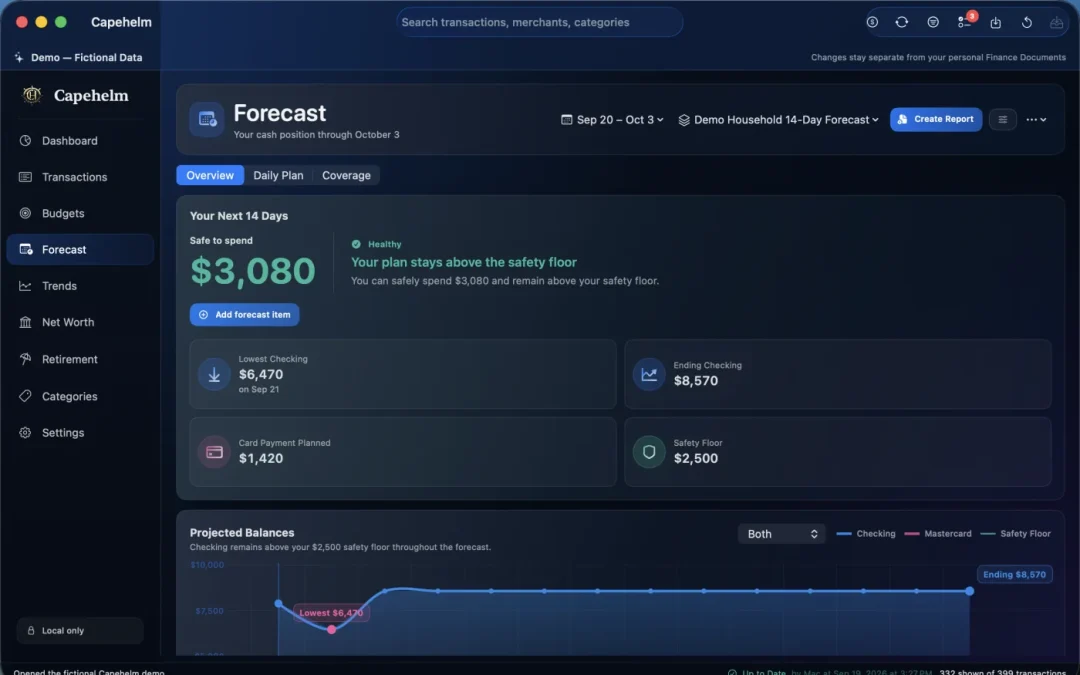
Capehelm Forecast, shown with fictional demo data.
17 · The takeaway
The takeaway
You don't need a complicated financial model to start forecasting your household cash flow.
Start with the money available today. Add the income you reasonably expect. Subtract the obligations you know are coming. Allow for normal everyday spending. Then work forward chronologically.
Most importantly: don't just look at where the forecast ends.
Look at the path. Find the lowest point. That's often where the useful information is hiding.
Your bank balance tells you where you are.
Your budget tells you what you planned.
A cash-flow forecast helps you see where you're heading.