
Budgeting · Forecasting
Budget vs. Cash-Flow Forecast: What's the Difference?
A budget tells you what you planned. A cash-flow forecast tells you what's about to happen. You need both.
- 01BudgetPlan
- 02ActualsWhat happened
- 03ForecastWhat happens next
Most people think that if they have a budget, they know where their finances stand.
But imagine this:
You've budgeted $1,200 for groceries this month. You've spent $850. Great—you're under budget.
Your chequing account has $3,400 in it.
Then over the next ten days:
- your mortgage payment comes out
- your credit-card payment is due
- childcare is withdrawn
- you get paid
- your electricity bill comes out
Are you actually in good shape?
Your monthly budget can't fully answer that question.
That's where a cash-flow forecast comes in.
01 · The plan
A budget answers: “What do I want to happen?”
A budget is your financial plan.
You estimate your income and decide how much you expect—or want—to spend across things like housing, groceries, transportation, entertainment and savings.
At the beginning of the month, your budget might look something like this:
| Category | Monthly plan |
|---|---|
| Housing | $2,500 |
| Groceries | $1,200 |
| Transportation | $600 |
| Utilities | $450 |
| Entertainment | $300 |
| Savings | $1,000 |
As transactions happen, you compare your actual spending against that plan.
That makes a budget very good at answering questions such as:
- How much did we plan to spend?
- Are we overspending on restaurants?
- Can we afford to increase our savings target?
- Where is our money actually going?
But there's something important missing:
time.
02 · The sequence
A forecast answers: “What happens next?”
A cash-flow forecast starts somewhere different.
Instead of asking how much you intend to spend this month, it starts with the money you actually have available today. Then it looks forward.
Suppose you have $3,400 available on September 28. You know several things are coming:
- Starting balanceNo change$3,400
- Mortgage−$1,850$1,550
- Paycheque+$4,200$5,750
- Electricity−$240$5,510
- Credit card−$3,100$2,410
- Childcare−$600$1,810
Suddenly you can see something a monthly budget doesn't show very well: the sequence of your money.
You aren't simply asking whether income exceeds expenses.
Will the money be there when I need it?
That is a different problem.
03 · Three connected views
Budgeting and forecasting aren't competitors
You don't have to choose between budgeting and forecasting. They solve different problems.
Here's what we planned.
Here's what actually happened.
Based on what we know now, here's what's likely to happen next.
Together, those three views create a much more useful picture of your finances.
And they're remarkably similar to how large projects are managed.
04 · The origin
The idea came from project engineering
I'm a project engineer.
I've spent years working with projects where understanding the numbers isn't enough. You need to understand what has happened, compare it with the plan and continually look ahead at what is coming.
Eventually I realized something: I wasn't applying the same thinking to my own finances.
A household isn't an engineering project, of course. But some of the basic questions translate surprisingly well.
- What happened?
- Where did our money actually go? How does that compare with the plan? Are we spending roughly where we expected?
- What's coming next?
- What payments, income and other commitments are approaching?
- Are we moving in the right direction?
- Is our longer-term financial position improving?
Those questions eventually became part of the thinking behind Capehelm.
05 · A practical horizon
Why I like a short forecast
You can forecast household finances months or even years into the future. But there's a trade-off.
The further you look ahead, the less certain everyday spending becomes.
I find the next two weeks particularly useful. It's long enough to capture things like:
- upcoming paycheques
- mortgage or rent
- credit-card payments
- recurring bills
- subscriptions
- transfers
- known larger purchases
But it's short enough that you generally have a reasonable idea of what's actually going to happen.
The goal isn't to predict every coffee you'll buy next Thursday. It's to identify the important movements of money before they happen.
06 · Try it yourself
A simple way to do this yourself
You don't need special software to build a basic personal cash-flow forecast.
- 01Start with today.
Write down your current available balance.
- 02List the next 14 days.
Add the significant transactions you know are likely to occur.
- 03Run the balance forward.
Add income, subtract expenses and calculate the expected balance after each one.
- 04Notice the low points.
Look for the places where your projected balance becomes uncomfortable.
A spreadsheet can do this perfectly well.
If you want to build one step by step, the guide to forecasting your personal cash flow for the next 14 days walks through the timeline, estimates and low point.
Maybe the month looks fine overall, but three large payments land before your next paycheque. That's useful information before those payments happen.
07 · The product view
Where Capehelm fits
This is one of the reasons I built Capehelm with separate Budget, Trends and Forecast views.
They aren't different ways of displaying the same information. They answer different questions.
- Trends helps you understand what happened.
- Budget helps you make a plan.
- Forecast helps you look ahead.
And Net Worth and Retirement pull the camera back further to help you understand the bigger picture.
Capehelm's Forecast focuses on the next 14 days because I wanted something practical enough to use regularly—not an elaborate financial model that gets abandoned after a week.
Because Capehelm is local-first, that analysis can be done from financial data you import yourself rather than requiring you to connect your bank accounts.
If you're weighing that choice, the guide to personal finance apps and bank access explains the convenience-and-control trade-off.
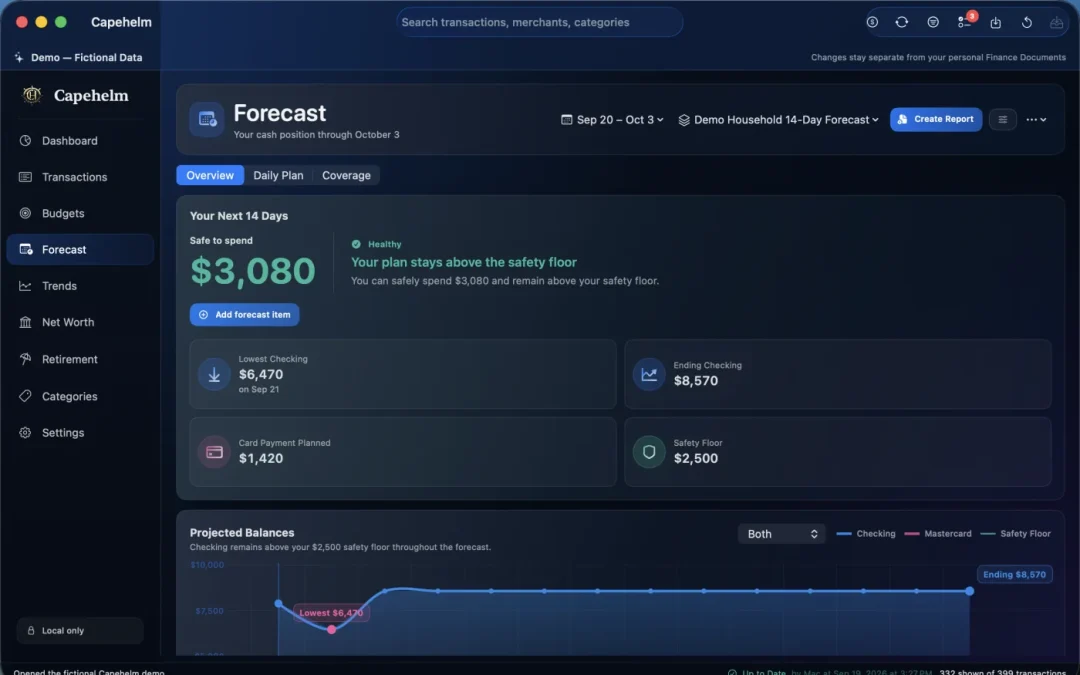
Capehelm Forecast, shown with fictional demo data.
08 · The takeaway
The takeaway
A budget can tell you that you're under budget for the month while your bank balance is about to get squeezed.
A healthy bank balance today can make you feel comfortable while several large payments are sitting just around the corner.
That's why I don't think of budgeting as the whole system.
I think about personal finances as a repeating cycle:
Understand what happened→Make a plan→Look ahead→Repeat
A budget helps with the plan.
A forecast helps with what comes next.
You need both.